Popular Chemistry Online

Link ad

Followers

Sunday, January 2, 2022

Electrolytic cell

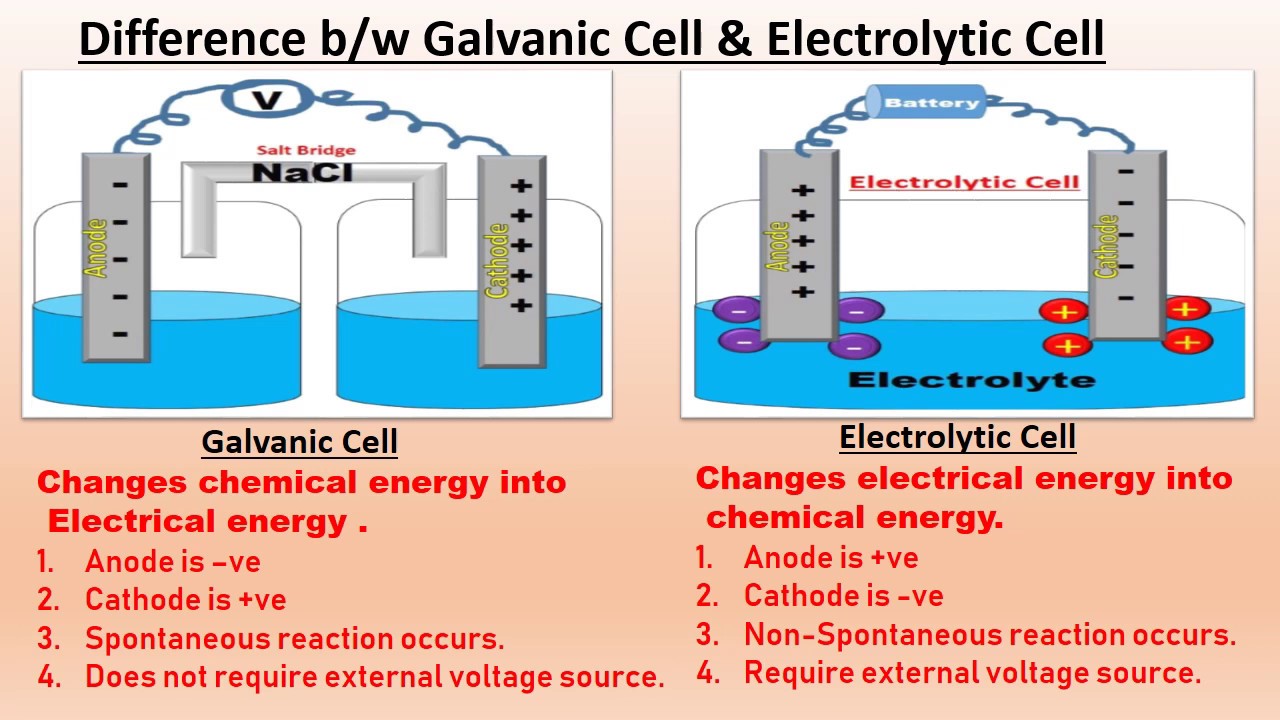
This is a device  which brings about a chemical change by means of electric current supplied. 

In this cell two electrodes are  dipped in same container.

 electricity from outside source supplies electrons for the non-spontaneous reaction.R

Reduction takes place cathode where metal from electrolytic solution gets deposited.

ü  oxidation takes place anode  from where metal goes into the electrolytic solution.


Corrosion And Prevention of corrosion

  •   Corrosion is the oxidative deterioration of metal.
  •   25% of steel produced goes to replace steel structures and products destroyed by corrosion.
  •  Rusting of iron requires the presence of both oxygen and water.
  •   Rusting results from tiny galvanic cells formed by water droplets.

Prevention of corrosion

  •  Galvanizing: is the coating of iron with zinc. Zinc is more easily oxidized than iron, which protects and reverses oxidation of the iron.
  •   Cathodic Protection: is the protection of a metal from corrosion by connecting it to a metal (a sacrificial anode e.g. Mg or Zn) that is more easily oxidized.
  •   Electroplating.
  •   By applying paint, grease, rubber to prevent contact of metal surface from air.


Electrolytic cell and electrolysis

  •  Electrolysis: It is the process in which electrical energy is used to drive a non-spontaneous chemical reaction.
  •   An electrolytic cell is an apparatus for carrying out electrolysis.
  •   Processes in an electrolytic cell are the reverse of those in a galvanic cell.

Electrolysis process is used in  Manufacture of Cl2 and NaOH, Electro-refining and Electroplating, Electrolysis of water


Difference between Galvanic cell and electrolytic cell


Nernst Equation for a Daniell cell

  •    Nernst gave a relationship between electrode potentials and the concentration of electrolyte solutions known as Nernst equation.
  •   Reduction Potential under Non-standard Conditions is  determined using Nernst Equation when Concentrations is not-equal to 1M. Thus For the cell

For Daniel cell,

Zn(s)+Cu2+(aq) 🠊 Zn2+(aq) + Cu(s)

Zn(s)|Zn2+(aq)||Cu2+(aq)|Cu

In Daniell cell, the electrode potential for any given concentration of Cu2+ and Zn2+ ions, we write

For Cathode:

E(Cu2+/Cu) = E0(Cu2+/Cu) – RT/2F ln(1/[Cu2+(aq)]

For Anode:

E(Zn2+/Zn) = E0(Zn2+/Zn) – RT/2F ln(1/[Zn2+(aq)]

The cell potential, Ecell = E(Cu2+/Cu) - E(Zn2+/Zn)

= E0(Cu2+/Cu) – RT/2F ln(1/[Cu2+(aq)] - E0(Zn2+/Zn) + RT/2F ln(1/[Zn2+(aq)]

= E0(Cu2+/Cu) -E0(Zn2+/Zn)- RT/2F ln(1/[Cu2+(aq)] + RT/2F ln(1/[Zn2+(aq)]

= E0(Cu2+/Cu) -E0(Zn2+/Zn)- RT/2F (ln(1/[Cu2+(aq)]- ln(1/[Zn2+(aq)])

Therefore, Nernst equation for Daniel cell is

Ecell = E0cell - RT/2F ln [Zn2+]/[Cu2+]

Ecell = E0cell − 2.303RT/2F ln [Zn2+]/[Cu2+]

by putting the value of R= 8.314J/KM ,T=298K, ln=2.303log and F=96457C

Ecell =E0cell − 0.059/2 log[Zn2+]/[Cu2+]


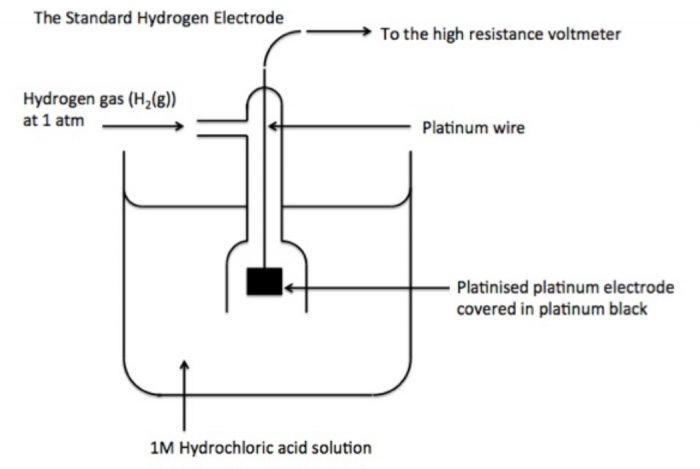
STANDARD HYDROGEN ELECTRODE (SHE)

 ü  It is reference electrode consists of a platinum electrode(Pt wire fitted in glass tube) in contact with H2 gas (1 atm) and aqueous H+ ions (1 M).

ü  It is assigned 0.0 V electrode potential.

ü  It may behave as anodic or cathodic half cell.

ü  It is represented as

          Pt(s)|H2(g)(aH2= 1)|H+(aq)(aH+ = 1).

   ü  When SHE is coupled with an other  half cell then cell potential is the value of the electrode potential of half cell.


EMF and Electrode Potential

EMF: (electromotive force): It is the electrode potential difference across the terminals of the cell when no current is drawn through the cell.

Electrode potential. It is the potential difference develops between the electrode and the electrolyte.

Standard electrode potential : When the concentrations of all the species involved in a half-cell is unity then the electrode potential is known as standard electrode potential.

feature post

Important questions of biomolecules

BIOMOLECULES QUESTIONS VSA TYPE QUESTIONS (1 - MARK QUESTIONS) 1. Name polysaccharide which is stored in the liver of animals. 2. Wh...